Ask ten developers for the best tech stack and you'll get eleven answers. The truth is less exciting and more useful: for the vast majority of web products, a small, boring, well-supported stack beats a clever one. Here's what we build on, why, and when we deviate.
1. Principles before tools
We pick tools that are well-documented, hire-able, and unlikely to disappear. 'Boring technology' isn't an insult — it's a feature. The novelty budget is best spent on your product, not your plumbing.
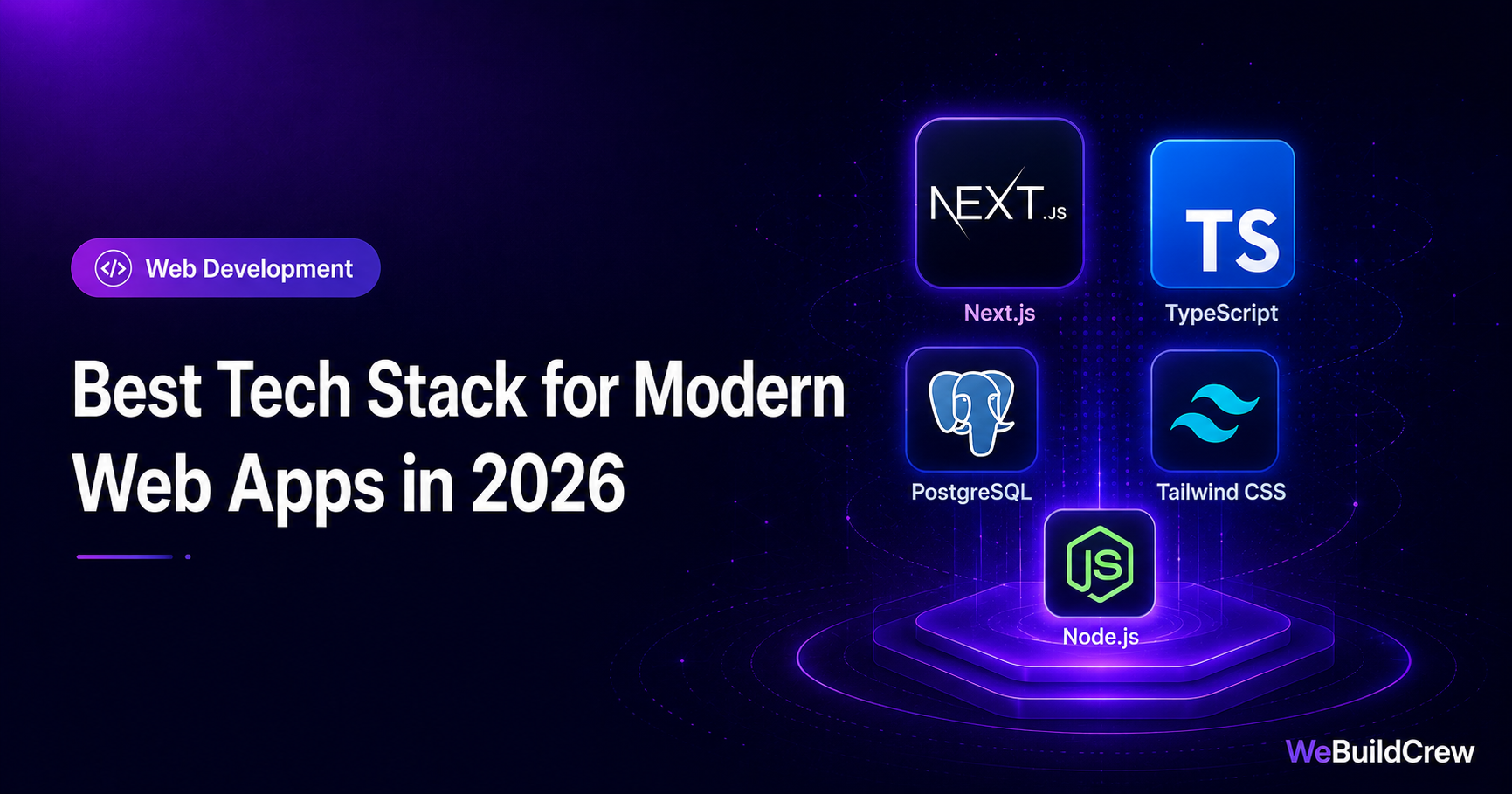
2. Frontend: Next.js + TypeScript + Tailwind
Next.js gives us server rendering for SEO, a component model, image optimisation and routing out of the box. TypeScript catches whole classes of bugs before they ship. Tailwind keeps styling fast and consistent without a 5,000-line CSS file.
export default async function Page() { const posts = await getPosts(); // runs on the server return ( <main className="mx-auto max-w-5xl px-4"> {posts.map((p) => ( <Article key={p.id} post={p} /> ))} </main> );}3. Backend & database: Node + PostgreSQL + Prisma
PostgreSQL is the most capable open-source database you can run, and Prisma gives us a type-safe layer over it so your database types flow all the way to the frontend. For most apps, Next.js API routes are enough; for heavier workloads we split out a dedicated service.
import { db } from "@/lib/db"; export async function GET() { const projects = await db.project.findMany({ where: { status: "active" }, select: { id: true, name: true, updatedAt: true }, orderBy: { updatedAt: "desc" }, }); return Response.json(projects);}When to reach for something else
- ✓Realtime-heavy app → add a dedicated WebSocket/Socket.IO service
- ✓Search-heavy app → add Meilisearch or Elasticsearch
- ✓Massive read scale → add Redis caching and read replicas
- ✓Mobile → React Native sharing types with the web app
4. Hosting, CI & observability
Vercel / Node
Deploys & edge CDN
GitHub Actions
CI: lint, test, build
Sentry
Error tracking
Postgres host
Managed, backed up
src/ app/ # routes (App Router) components/ # reusable UI lib/ # db, auth, utils, integrations config/ # constants, env-driven config styles/ # global tokensprisma/ schema.prisma # single source of truth for dataWhy this stack wins
- Frontend
- Next.js · TypeScript · Tailwind
- Backend
- Node · PostgreSQL · Prisma
- Related service
- Web Development
Need this built? Explore our Web Development service.
View service →Written by Zahid Ghotia · Published 30 April 2026 · 10 min read