Ask ten agencies what a website costs and you'll hear ten answers between $50 and $50,000. Both ends can be honest — they're just quoting very different things. This guide breaks down what websites actually cost in 2026, what you get at each price, what makes a quote go up, and how to get a professional site without overpaying.
$49
Landing page
$99
5-page business site
$500+
Web app / SaaS
The short answer
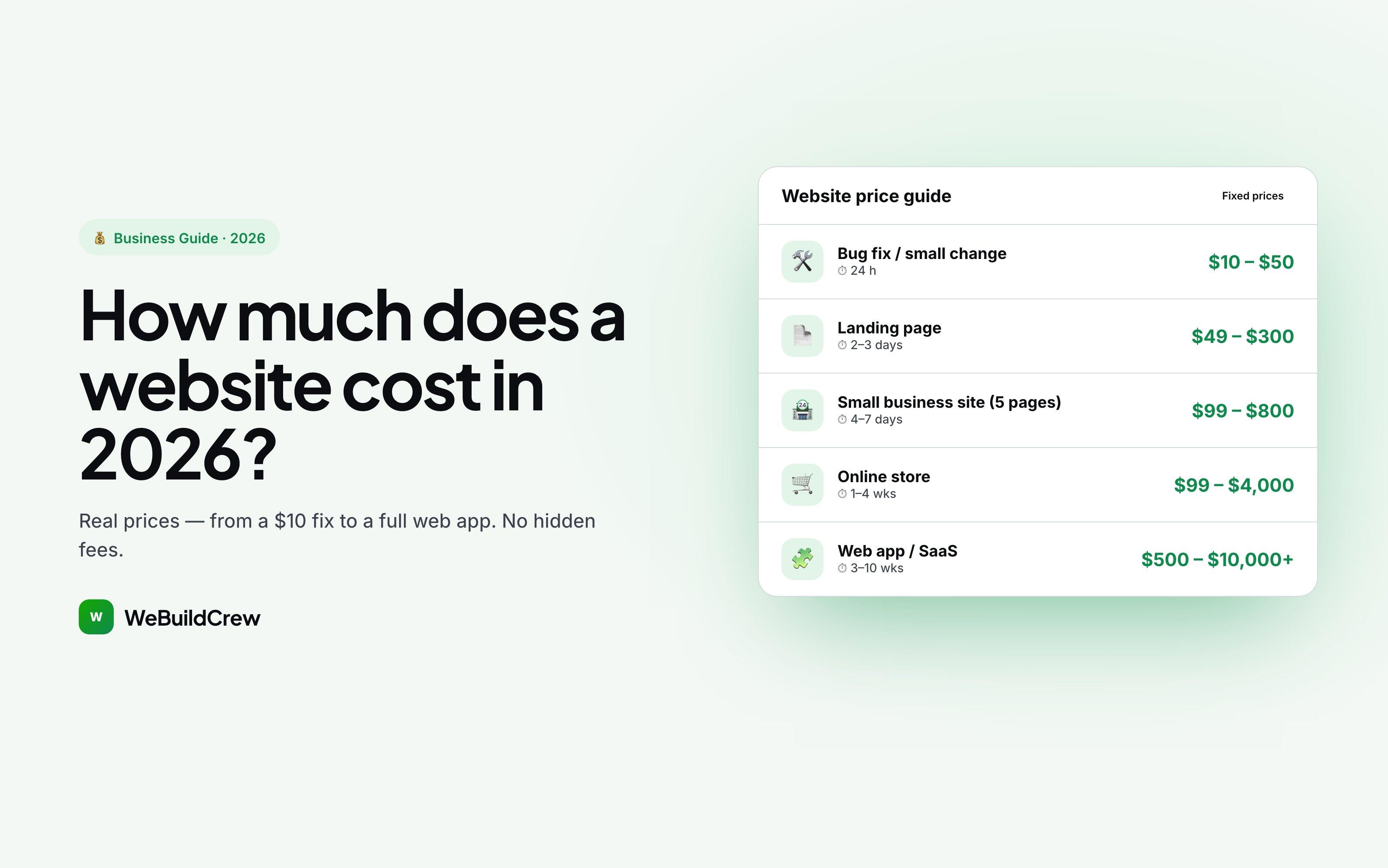
In 2026, a simple professional website costs $49–$800, an online store $99–$4,000, and a custom web app or SaaS product $500–$10,000+. Small fixes and changes to an existing site start around $10. The real price depends on how many pages you need, custom features, integrations and who builds it.
- Bug fix / small change
- $10 – $50 · within 24 hours
- Landing page (1 page)
- $49 – $300 · 2–3 days
- Small business website (up to 5 pages)
- $99 – $800 · 4–7 days
- Online store
- $99 – $4,000 · 1–4 weeks
- Marketplace / booking platform
- $800 – $12,000 · 4–12 weeks
- Web app / SaaS
- $500 – $10,000+ · 3–10 weeks
- Monthly maintenance
- $29 – $150 / month
Website cost by type
1. Landing page — $49 to $300
One page with a single goal: collect leads, sell one product or promote an event. A good landing page has a clear headline, benefits, proof (reviews or logos), an FAQ and one obvious call to action. It should load in under a second and send every enquiry straight to your email or WhatsApp.
2. Small business website — $99 to $800
Home, About, Services, Portfolio or Blog, and Contact. This is what clinics, restaurants, salons, consultants, contractors and local shops need. The price rises with custom design, copywriting, booking systems, multiple languages or a CMS so you can edit content yourself.
3. Online store — $99 to $4,000
A basic store with a few products and card checkout sits at the lower end. Costs rise with hundreds of products, custom product options, multi-currency, crypto payments, inventory syncing or a custom (headless) storefront built for speed.
4. Web app, SaaS or marketplace — $500 to $10,000+
Anything with user accounts, dashboards, payments between users or real-time features. A focused MVP can start around $500–$2,500; a multi-tenant SaaS or two-sided marketplace with payouts, admin panel and mobile apps can reach $10,000 or more.
What actually drives the price
- ✓Number of unique page designs (not total pages — 50 blog posts share one design)
- ✓Custom features: booking, user accounts, payments, dashboards, search
- ✓Integrations: CRM, email marketing, WhatsApp, Stripe, PayPal, crypto, shipping
- ✓Content: whether you provide text and photos or need copywriting
- ✓Design: template-based vs fully custom brand design
- ✓Who builds it: a local agency, a freelancer or a remote team
Agency vs freelancer vs remote team
- ✓Local agency (US/UK/EU): $3,000–$30,000 for a business site. Great service, high overheads.
- ✓Marketplace freelancer (Fiverr, Upwork): $50–$2,000. Cheap, but quality varies and platforms add 5–20% in fees.
- ✓Remote senior team with fixed prices: $49–$5,000 for most sites. Agency-level quality without agency overheads.
Running costs after launch
- ✓Domain name: about $10–$20 per year
- ✓Hosting: $0–$20/month for most business sites (Vercel, Netlify and similar have free tiers)
- ✓Business email: $0–$6 per user/month
- ✓Maintenance and small updates: optional, from about $29/month
- ✓Paid plugins or apps: only if your site needs them
How to get a great website without overpaying
- 1
Write a one-page brief
Your goal, pages, must-have features, 2–3 sites you like and your budget. A clear brief can cut a quote by 30%.
- 2
Start with an MVP
Launch the pages and features that bring customers now; add the rest once the site earns.
- 3
Get a fixed price in writing
Scope, timeline, revisions and what happens after launch — all agreed before you pay.
- 4
Own everything
Domain, hosting and source code should be in your name from day one.
- 5
Pay in milestones
A small upfront payment, the rest as each stage is approved.
“The cheapest website is the one that brings you customers. Pay for speed, clarity and a clear call to action — skip everything else until the site earns it.”
Need this built? Explore our Web Development service.
View service →Written by Zahid Ghotia · Published 27 September 2026 · 9 min read